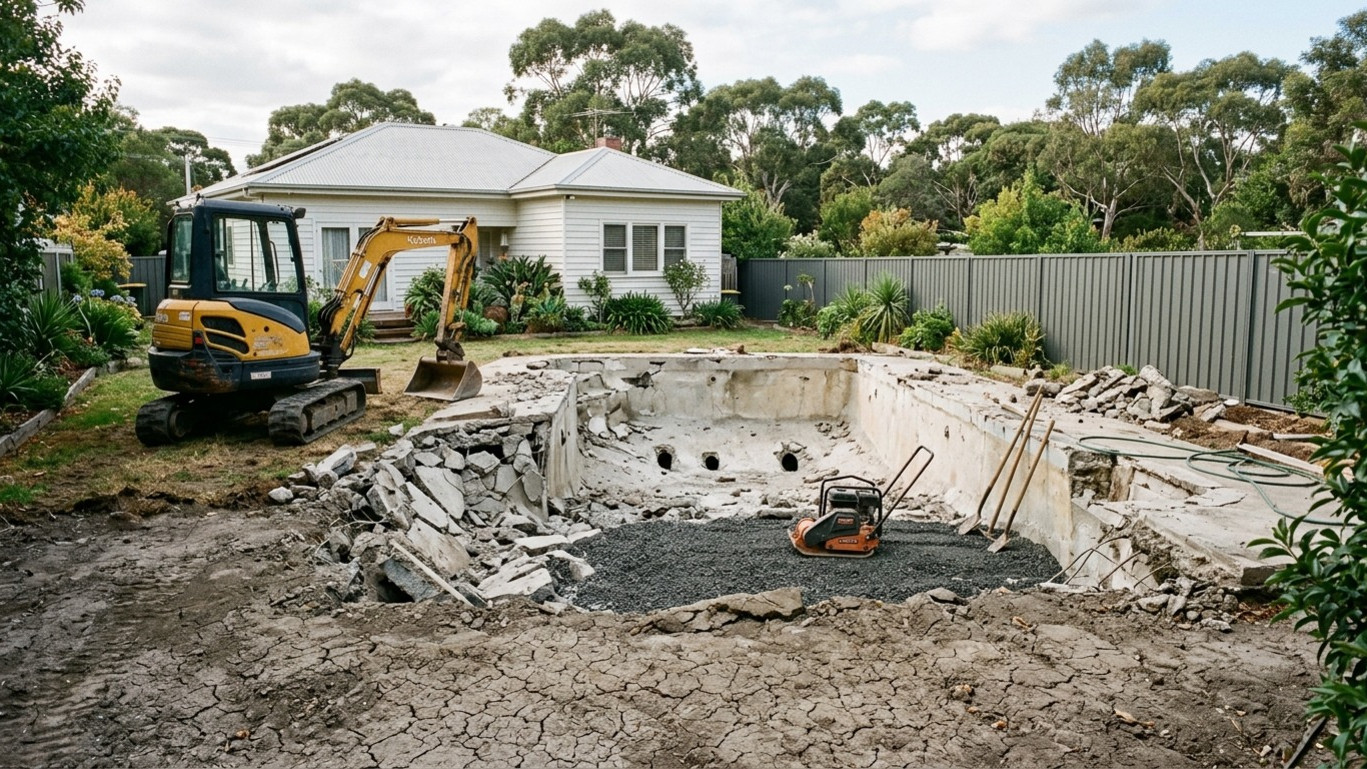
Look at an aerial photo of almost any established Melbourne suburb and the pattern jumps out. Pools tucked hard against back fences, squeezed down the side of the house, or running parallel to a neighbour’s garage with barely a path between them. Blocks got smaller over the decades, and pools got pushed into whatever space was left. Taking one of those out is a different job from clearing a pool in the middle of an open lawn, and most of the difference comes down to what’s standing next to it.
A pool wall can be holding up more than water
A concrete pool shell is basically a big rigid box sunk into the ground. Put it a metre or so from a house slab or a boundary fence and the soil in between has spent years leaning on it. Break the wall out carelessly and that soil can slump straight into the hole. Sometimes it takes a few fence posts with it. Sometimes it’s the edge of a footing.
You can’t tell how much load a pool wall is carrying just by looking at it. Nobody can. That’s why, on a tight site, the order the work happens in matters as much as the machine doing it. A crew who knows what they’re doing will break out the wall in sections near a structure and backfill as they go. What they won’t do is leave a long open trench running along a fence line overnight.
Vibration is the part neighbours actually feel
Hydraulic breakers get through concrete fast. They also send vibration through the ground, which is a real worry next to a brick wall or an old weatherboard sitting on stumps. Tiled bathrooms don’t love it either. The usual complaint is hairline cracks in plaster. Rarely structural, but no fun to argue about after the fact.
Near anything sensitive, a careful operator will switch to a smaller breaker, saw-cut the concrete into manageable pieces, or lift sections out rather than hammering them in place. It’s slower work, and it costs a lot less than patching a neighbour’s render.
One cheap protection sits with you, not the contractor. Photograph nearby walls, paving and the neighbour’s side of the fence before anything starts. Date-stamped photos settle most “was that crack there before?” conversations in about thirty seconds.
When the neighbour’s property comes into it
Victoria has a formal process for building work that could affect an adjoining property. Where the relevant building surveyor decides a neighbouring structure needs protecting from demolition or excavation, the owner carrying out the work has to serve a Protection Work Notice (Form 7 under the Building Regulations) before work starts. Plenty of pool removals won’t need one. Whether yours does depends on the surveyor, the permit and how close the dig sits to the adjoining structures.
Even without a formal notice, a chat over the fence a couple of weeks ahead goes a long way. Tell them which days the machinery is on site, whether trucks will be across the driveway, and that you’ve photographed their side of the fence. Most disputes on these jobs start with somebody being surprised.
What changes on a job tight to the house
A lot of inground pool removal in Melbourne happens on exactly these kinds of blocks, and a crew used to them plans around a few things before the first machine rolls in:
- Smaller machines that can work beside a wall without the bucket or counterweight swinging into it
- Section-by-section breakout next to structures, so the surrounding soil is never left unsupported for long
- A Before You Dig Australia search for gas, water and electrical lines, which on narrow side setbacks often run right where the digging needs to happen
- Extra care along the pool edge nearest the house, where the pool’s own pipework and old stormwater lines tend to cluster
Before signing anything, ask the contractor how they’ll handle the side closest to the house or fence. Ask what machine size they’re planning to bring in, and whether they’ve done similar work within a metre or two of a structure. Someone who does this regularly will describe the sequence without hesitating. A quote that treats a pool jammed against a garage wall the same as one sitting in open lawn probably hasn’t looked hard at the site.
Reverse Pools has been working in Melbourne backyards for more than 30 years. The tight, awkward jobs other contractors walk away from are a big part of that, and the machinery is set up for exactly those sites. If your pool is jammed up against the house or a boundary, ring the team on 0433 377 969 and get someone out for a look before you settle on a plan.